
SEVEN DAY CYCLIST
CYCLING, BUT NOT USUALLY RACING
LATEST UPDATE September 22nd 2026
HOW DO WE REACH THE OVERALL RATINGS FOR PRODUCTS WE REVIEW?
THIS SITE USES GOOGLE ANALYTICS TO ANALYSE TRAFFIC. CONTINUING TO USE THIS SITE MEANS YOU ACCEPT THE USE OF COOKIES.WE DO NOT COLLECT PERSONAL DATA LEARN MORE OR SEE OUR PRIVACY POLICY
Magicshine Hori 900 Switchable Bicycle Lamp
(£59.99) 105g with mount adaptor MJ-6538 112g outfront mount (£13.99) 46g, MJ-6588 remote control (£19.99) 15g
The Magicshine Hori 900 is a rechargeable, switchable front light. It can sit atop the bar or underneath, can have a GPS mounted above, and more. Lots to like there. However, mount and remote control will need to be purchased separately. Put them all together and you have a lot of options – as well as a lot of little bits to put somewhere safe in case you change your mind. There are plenty of nice features in the lamp itself, too, with sensible modes, a specific day light running option, and pairing up with the Magicshine App.
Pros: compact, flexible mounting options, IPX6 rating, pairable with some Magicshine lights, low-beam lens for anti-dazzle.
Cons: remote and mount not included, little peripheral light bleed.

Specification
Aimed at the day to day road cyclist, the Magicshine Hori 900 is a bijoux little lamp that can be mounted above or below the bars. With built in capacity to fit Wahoo and Garmin type mounts and to sit a GPS atop the lamp, it offers a lot of flexibility as well as up to date optics to make the most of the output. Power comes from a long-lasting 2000mAh battery with fast USB-C charging.
Other key features are and IPX6 waterproof rating, lockout mode to prevent accidental activation, and memory function for the previous setting
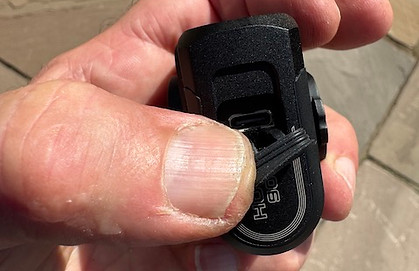
The lamp itself sits in the palm of the hand quite comfortably. Build feels sound. The case is aluminium, robust and handy for heat dissipation – even without ribs – mind you, at 900 lumens max heat should not be too much of an issue to the touch, but keeping things cool also helps the internal electronics work efficiently. On one side of the lamp is the rubber switch which also acts as a charge indicator, on the other is the charging port with a reassuringly sturdy rubber bung to keep the weather out; atop and below are integral brackets to fit Wahoo or Garmin mounts.

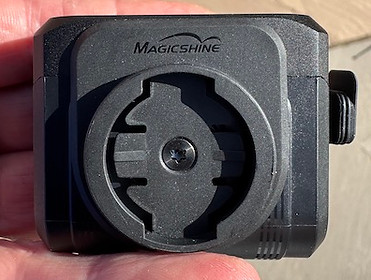
The beam is described as “cut-off low-beam” maintain the trend amongst more sophisticated bicycle lights to avoid dazzle for on-coming road-users whilst keeping a clear focus on where light is most needed. On a similar note, there is no built in side-on visibility, but the light does cast a broader beam than many road spotlights.
There are two day-light running modes (more on that later). Even better for those who love their apps, the light can be paired with Magicshine’s smart rear lights and customised through the app for preferred pre-sets for different scenarios. Not everyone will rejoice at this, but there are plenty of people who will see it as a real plus point. Even better, and this is, of course, very necessary with underslung lights, their MJ-6588 remote control (this needs to be purchased separately).
That is pretty much it, except to say that in the box with the light unit, you will find a Go-Pro adaptor, a Wahoo mount base, a USB-C charging cable, and a useful 3mm Torx key, as well as a “decorative cap” for those who like to keep things aesthetically pleasing. There’s an instruction manual, too.

However, if you have bought the out-front mount, too, then there’s more to come. A handy little pack of tools for mounting and a number of adaptors that go as far as one for Bryton GPs units and an adhesive mount for the back of your phone. This, of course adds even more to the mounting options, and that is where we will go next.
Mounting 4/5
The light unit comes ready to mate with Garmin and Wahoo, whether atop or slung under the bars. Of course, you do not need to buy a new bracket to mount it on. Both of the above are [pretty common these days and you may already have something suitable. Just remember that cheaper versions may be less precisely moulded than brand specific ones or pricier models. I’ve certainly used a bargain basement bracket with a Garmin adaptor which gave me distinct heebie-jeebies when hitting bumpy bits of my commute along the canal towpath.
If you go for the out-front mount, which Magicshine were kind enough to send me along with the light, you’ll find it equipped with a mixture of adaptors and shims. The latter should allow it to be mounted to any round bars, although the Jones bars took a bit of bodging as they are pretty slim out front and, in one case in my fleet, are completely covered in Fizik bar tape. On other bars, no issue. A firm fix was simple to achieve.

Whether the light is best mounted above or below is a matter of choice, - and you’ll probably have plenty of space to allow for both options if you wish - leaving an out-front mount for GPS and a Go-Pro (alternatives are available). It should take the weight of three devices – Magicshine do not advise against it as they do for the Hori 1300. However, in reality, I have found that with GPS on top and in easy view, the light cannot be angled down – not a problem in day-light running mode, but not good if you aim 900 lumens straight ahead without angling the light down. Thus, I’ve preferred the underslung position for the lamp as I do a good deal of night riding. And rarely require a Go-Pro.
For the Hori 1300, Magicshine feel that the light plus GPs may prove too heavy for the mount. Whilst they do not say this for the Hori 900, I have found that a larger GPS unit, such as my preferred Wahoo Elemnt Ace, can put a tad too much weight on the mount and push it down. This has not been the case with the lighter Garmin Edge units, some of which are over 100g lighter.
All this flexibility does create a bit of an issue. Ensure things are properly set up for the combination you desire. Remember, the two mounts that come fixed to the lights can be removed and switched from top to bottom and bottom to top.
The remote control is secured with a simple rubber o-ring style strap. It feels suitably sturdy and will mount pretty much anywhere on the bars that you want it. On the drops I tend to put these things on the inside of the hoods for easy use with my thumb. On the Jones bars or flats, I go for anywhere within easy reach of the grips.
Switch and remote 3.5/5
The light switch, which also acts as a charge indicator, is situated on the right side of the lamp when it is mounted on top of the bars. It is easy to operate, even with full-finger gloves. However, atop or underslung, using the remote makes things much easier, especially when changing modes on the go. Fundamentally, I’d recommend it. Do it in aid of good relations with others – it is much safer and quicker to dip the light for oncoming vehicles or pedestrians (on a shared cycle path, such as my local canal towpath).
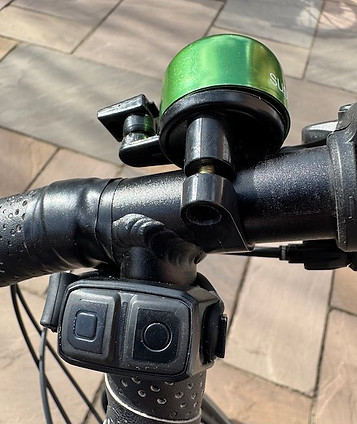
Familiarising oneself with the patterns of clicks required to switch between modes is a good idea before hitting the dark lanes. I’ll not go through them here, it is all simple enough, but daylight running and night modes require a double click to switch between the two sets. I often find these things quite challenging, you may well not.

The remote is rechargeable – unlike many that employ replaceable batteries. You’ll need to ensure it is paired with your lights, which is a tad fiddly, but easy enough if you follow the instructions that accompany it. It has its own lockout function, too, just hold both buttons for five seconds – reverse the function in the same way.
The remote allows you to toggle through the modes as you would with the switch. Personally, I’d regard it as vital to get the most out of the Hori 900. It’ll add around £19.99 to the package. That’s not just because of convenience, but because, some might think strangely, two of the seven modes (day and night flash) are only available through the remote control.
Charge and run times 3/5
Stated charging times for both light and remote is 2.5 hours – that is two and a half hours rather than 2 hours and 50 minutes. When fully charged the indicator on each of them will show a constant green light. This was pretty much matched by experience – from zero to full. As I am regularly told, we should, of course, not allow the charge to run down to zero. Charge time is also, pretty standard for a battery like this and similar lights.
Real time charge can be seen by pressing the button for two seconds. Green shows anything between 100% and 21%; red 20%-11%, and flashing red 10%-1%. No problem really, but personal preference is for an earlier indication that things are getting low, say around 30% to 40%. The remote can be used to see both light and remote charge. Detail is in the user manual. This is particularly useful when the light is underslung, the charge indicator on the unit being pretty much obscured by other handlebar paraphernalia.
Run times seem to me to be pretty much what one expects for a light of this power. Of course, it can be topped-up from a power-bank.
Run times are; main constant 200 lumens (low) 3.5 hours, 400 lumens 2.5 hours, 900 lumens (1.5 hours); DLR mode constant 50 lumens 7.5 hours, flash 50 – 0 lumens. In flash mode- remember, only available through the remote, day flash 0 – 50- 0 lumens 30.5 hours, night flash 30-200-30 15 hours. The latter is pretty good, and certainly makes a case for this as a back-up, maybe for a dynamo light, with a very good output as an auxiliary should conditions demand.
Run times are pretty much in-line with similar lights at this price point. In practical terms the 400 mode gives me three and a half commuting to work trips. Day flash is very decent – and bright enough, too. That’ll do for a few long day rides on cloudy autumn days. Top end steady is enough for a bit of extra speed and the odd diversion or for a speedy training session, but, as you’d expect, more than that will need a bigger light or a powerbank.
Modes and output 3.5/5
The beam provides broader illumination than many road lights – handy for finding the edge and for cycle paths and when you hit unlit tracks. The brightest light forms an upside-down trapezium with very sharp cut-offs (although the front edge of the beam is curved, it is less so than on other lights I have tried, even with low-beam design. There’s wider illumination too, of course, but forward bleed is more limited than some models, say the Sigma Buster 800. At full 900 this is plenty of light for bashing along on an unlit country lane – or weaving more carefully between the pot-holes. It is grand for my pre-dawn commute along the canal tow-path. Narrowed by overgrown shrubs in some places, that wide beam sure gives a great deal of certainty where the path water starts. On the other hand, there’s not a lot of useful illumination beyond the end of the beam, which shows how effective the anti-dazzle lens is.

Having said the, at a more sedate commuting pace – more my norm these days (say around 10-12mph) – the 400 mode has been sufficient on the towpath, sections of unlit lanes, and gives good presence when I hit the city streets – of course, these are all familiar territory. Low steady is fine for lit streets in suburbia, but I’d tend to go for the 400 in heavier traffic, particularly if I’m going to be negotiation major junctions, either that or add a blinkie.
900 has seen oncoming drivers dipping lights immediately on coming into sight. Given the cut-off beam, it tends not to light up the hedgerows so much, so dipping before coming around the corner has been less common. Point is, as you’d hope, there’s been no time when I have felt invisible or peripheral, even on roundabouts.

With overcast days more common as autumn comes on, the day flash has proved particularly useful. On tour on a squally day in the Scottish Highlands, I resorted to DLR flash during showers. I also employed the night flash mode, which is brighter. The day flash seemed to be enough to maintain good behaviour amongst the on-coming drivers.
Care and durability 3.75/5
IPX6 waterproof ratings are not unusual, although, at this price point, far from de riguer. Expect protection from anything that nature is likely to bung at it in realistic cycling situations. This should be fine without mudguards, too. Do make sure that the robust rubber plug on the charging point is firmly pressed home.
Having used the light for a month, on tour and around home, you’d expect it to be keeping its good-looks. Eventually, there’ll be a few scratches, no doubt, but it has survived a very close encounter with a woody shrub and seems no the worse for the quick brawl.
Value 3.5/5
Whilst winter trainers and endurance riders will want longer run times and a tad higher top-end, mortals who want a bit of after-dark exploration, perhaps the Magicshine Hori 1300. In that context lights of this kind are ideal. There are plenty of them, too.
The Sigma Buster 800 (review to follow) may lack the low beam design, but, because of that the beam tails-off further ahead. It also has some neat options for customisation, but has no remote and does not have the same range of mounting options on the bar. Equally it can be helmet mounted with an after-market purchase helmet mount. It is a little cheaper, too, although not enough, in my opinion to seal a deal.
The Ravemen CR800 is a torch type, and has similar run times, but may offer a surprising amount to road riders, with potential for mixed surface cycling, too.
Then of course, there's Gaciron's Mars 1000 Bike Headlight, which produces, no surprise, 1000lumens, has IPX67 for weatherproofing, and includes a wireless remote in the bundle. Like he Hori, it has a cut-off or low-beam.
Of course, upping the budget a bit will get you a more powerful – and heavier – light, such as the Ravemen LR1200 and its PR1200 sibling, brings a more powerful top end along with extended mid ranges around the 400-600 lumens mark. Clealry, that additional spend just adds that bit more time to be out and about in a wider range of contexts. Equally, it may be overkill for what you want to do.
Summary
As a general rule of thumb, I put lights within a lumens range of 600-900 as “commuter plus”, suitable for many situations, but without allowing the high speeds of a winter trainer or extended off-road shenanigans. In that light, the Magicshine Hori 900 Switchable is competitive model: good for a day or two at the workplace and a little frolicking on the way home or moderate jaunts, but, in my opinion, best on the road.
Verdict: 3.5/5 As ever, good value for a competitive light from Magicshine.
Steve Dyster
https://magicshineuk.com/product/18887/
PUBLISHED OCTOBER 2025


