
SEVEN DAY CYCLIST
CYCLING, BUT NOT USUALLY RACING
LATEST UPDATE August 19th 2026
HOW DO WE REACH THE OVERALL RATINGS FOR PRODUCTS WE REVIEW?
THIS SITE USES GOOGLE ANALYTICS TO ANALYSE TRAFFIC. CONTINUING TO USE THIS SITE MEANS YOU ACCEPT THE USE OF COOKIES.WE DO NOT COLLECT PERSONAL DATA LEARN MORE OR SEE OUR PRIVACY POLICY
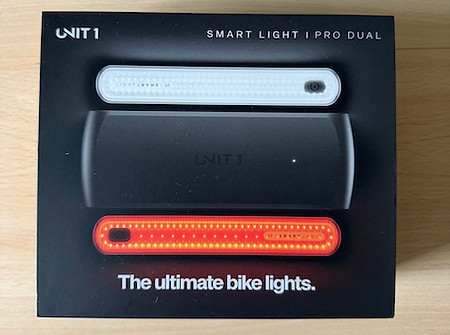
Unit 1 Smart Light Pro Dual
Lights and brackets (166g) Charging case empty (110g) £169
The Unit 1 Smart Light Pro Dual is the doubled-up version of Unit 1’s Smart Light, with the addition of a charging box that works in the same way as that used with ear-buds. As you’d expect a smart light comes with a lot of smart features which are compatible with a number of other products from Unit 1 and operable via their app. Overkill? Perfect? Tech at its best? That’s for you to decide depending on your preferences. I have come to like it – especially as day-job does not really approve of charging with their electricity – although it took me a little while to get into the intricacies of the whole system.
Pros: front and rear modes for flexibility, IPX5 waterproofing, charging case, easy to mount and store, tuneable, custom options, operable manually or via the remote control, chargeable by cable or charging box.
Cons: Navigation remote needed as an additional purchase, app needed for some features.
Specification
In the box you will find; two light units secure in the charging box, a single USB-C charger, two adjustable brackets, four mounting straps (two of each length), and an Allen (Hex-head) key. The app can be downloaded via the QR code, and there are basic instruction should you decide to go old-school (that’s me, folks), if only at first!
The lights and charging box feel pretty solid. Both are neatly made, and using magnets to secure the lights is a definite plus. These also secure them in the brackets.
Charging ports are not plugged by the usual rubber bung. However, they are different to the usual female port. In any case the IPX5 rating is reassuring. Charging in the charging box is courtesy of two small contact points. To make orientation easier, the lights only fit one way round. Same on the mounting bracket. This is also helpful for finding the mode you want.

These are powerful lights, by the way, although by no means unusually so. Front light offers a max of 200 lumens and the rear a max of 120 lumens. Not spectacular, but plenty, in my opinion – and they can be customised. I’ve followed cyclists with 400 lumens rear lights; it was not a pleasant experience. Yet, sensible output is not there only trick – brake lights and turning signals are included. These can be disabled.
The lights are long, twelve and a half centimetres. Since they can be mounted vertically or horizontally, that should not be an issue, unless you’ve unusual arrangements on your bars or elsewhere.
IPX5 is the water-resistance rating. Some boxes say 6, but I have been informed by a reliable source that this was a mistake. Five should be plenty for most real cycling circumstances.
You can get a lot out of the lights by just downloading the Unit 1 app. If you are buying onto the Neon or Aurora helmets you’ll definitely need that to make the most out of them. For the lights you need the app to customise modes. You might also want the remote control – an after-market purchase at £34.90 (see Unit 1 Neon MIPS Helmet test).
Mounting 4.25/5
Despite their distinctive length, the lights can be mounted in a number of different places, officially, and with a bit of bodging, some unofficial locations. A bit of care and the provided Allen Key (Hex Head Wrench) allows adjustment in both vertical and horizontal planes, a really useful feature.
There are four rubber straps supplied: two longer and two shorter. These are neatly made, despite being stoutly made, these are carefully shaped to fit into the hooks on the

bracket. They’re also different from traditional watch-strap types. One continuous slot with no lateral bands means that they are more limited when trying to fit to thinner or unusually shaped bars, racks, forks, stays etc. that’s easily remedied with a firkle in the spares bin: but make sure your ‘o’ ring or spare strap is robust enough.
I’ve managed to mount these on the seat-stay, the front fork, the seat post, bars, bar-bag mount. The only real limiting factor is if you have enough space to take the length. If you buy the Unit 1 commuting rucksack, it’ll mount on there, too. They’ll fit onto some Unit 1 helmets, as well – not the Neon that I have tested.
The use of magnets for mounting lights, disc-brake pads, and such like, is becoming more usual. Frankly, they are very effective, in my experience. So, these slip into the bracket and need a decent tug to remove. Certainly, bashing over gravel tracks and rattling setts hasn’t managed to send the light flying.
Switch and modes 4/5
A press and hold on the button, or on the remote, powers up or down. You immediately get to see the charge level, although some may find the display of lights on powering up and down a trifle bemusing. The manual switch requires a push and hold to power-on and off, and is not easily operable with a full-finger gloves. The remote is, once acquainted with it. Of course, the fact that the manual switch is not especially sensitive has the benefit of making accidental activation very unlikely.
The remote, once paired, is pretty easy to use. The remote unit only fits into the mount one way round – reassuring if using the signals. I have found this a bit fiddly, but you get used to it.
As for the lights, well, go on the app and play with the customisable options. There are pre-sets available, too. Be aware that your choice can impact run times. Having played around, I decided to stick with the pre-set they arrived with: solid and bright. It also enabled me to check out the stated run times.
Orientation of the light changes the mode from red to white and enables signal turns or prevents them. Hold for five seconds in the desired position to lock the mode. I have found this to mean a generous five seconds. I can hear one or two get up and go folk murmuring that they’ll be a ten second delay in the end of work Grand Prix.
Modes are solid 100% 3 hours, 50% 6 hours; beacon 100% 18hours, 50% 32 hours.

Charge and run times 3.75/5
Charging form the mains has taken around an hour and a half from zero, although I have tried not to let things run empty. Remember, every time you turn the light on or off you’ll be shown the charge remaining. Keep the case charged up and you really have no excuse for running out of juice. Unless heading out on a very long journey, you should get away with leaving that power-bank at home.
Charging in the case has been similar. Refuelling the case itself has taken around two hours. There’s a charge indicator on the case, which either flashes green or shows solid green.

Stated run times are as above. These seem to be pretty much spot on. Clearly, the brake light function and use of the turn signals will reduce run times. Neither is compulsory. That’s great for long miles in lighter or even no traffic. Although mixing it with rush hour traffic on city roads is a regular feature of my commuting, I’ve tended to do without the brake lights when hitting the longer quieter stretches of canal towpath and country lanes. In any case, because of the regular reminders of charge levels and the presence of the charging case in the pannier, a shorter run time is not necessarily the issue it is with brake lights that cannot be disabled or a sudden shock when the charge level goes unexpectedly into the red.
Run times are good, rather than spectacular, although the 100% beacon is impressive at 18 hours, but given the charging case, anticipation of low charge on arrival at work has become less stressful.
Care and durability 3.5/5
IPX5 designates protection against low pressure water jets and moderate to heavy rain. It’s generally regarded as fine for outdoor activities coming up short of submersion. Fundamentally, you could take the light into the shower, but not play with it in the bath. Why you should want to do either is beyond me, but if you have a good reason, I’d be curious to know it.
Rather nicely, the magnets on the lights can hold them together when sticking into pockets.
Performance 4/5
Firstly, as lights. Well, they are really to help you be seen, although 200 lumens on the front in lit suburban streets with light traffic is probably all you need, if push comes to shove, even if it is unfocussed. I’ve used the flashing mode on front and back in heavier traffic, as auxiliary lights, although the rear light provides plenty of presence as a solo. I am no expert in the impact of the lay-out of LEDs on how drivers see them. I guess a single source may seem brighter, but whether the multi-LED long and thin layout of the Unit 1 Dual is easier to spot, I do not know. Certainly, I have not felt unsafe at junctions or roundabouts. On a slightly different note, despite running the rear light at 120 lumens, a faster cyclist commented that the light was very clear but did not dazzle as he slip-streamed me for a few seconds before overtaking and disappearing round the next bend.
Both front and rear lights give good presence, as opposed to being visible, at over one hundred and fifty metres. Anecdotally, they got me spotted even further than that. That was at night in full darkness. Both certainly functioned well on one rain-swept dull day ride, with cars on narrow country lanes spotting me with ease at around two hundred and fifty metres, maybe further.

Theoretically, both lights could be seen from much further away, but our country lanes are rarely so straight. Cut things down to 50% and you still have effective presence as auxiliary lights. Good presence at over one hundred metres, easily. After all, they’re still kicking out 100 lumens to the fore and 60 lumens to the rear. Perhaps a real SOS or Eco mode would be handy? Although, you can tune such a mode in. In fact, as an auxiliary front light 200 lumens is far more then I find necessary. Frankly a two hundred lumens flash annoys me. I’ve dropped it to around 50 as a night auxiliary. In the day, I’ve tended to run it at 100 lumens, largely to eke out its life on longer rides.
Brake light functions seem, according to some research, to enable motorists to spot cyclists and estimate distance more accurately. Other research suggests it improves visibility, but makes proximity harder to judge. However, brake light function would be expected at this price point. Observers have told me, anecdotally, that the short burst of brighter light is very noticeable, with one colleague who followed me into work noticing it enough to ask me what it was all about and giving it the thumbs up. How much better it is than others is difficult to gauge, but it is an effective part of the system.
This brings me to the turn signals. Aging old fart that I am becoming, I have my doubts about how much motorists notice these or understand that they are indicators. No one claims that these are a substitute for hand signals, and maybe one day they will be standard on all bikes and fully understood by other road-users. At present they are not.
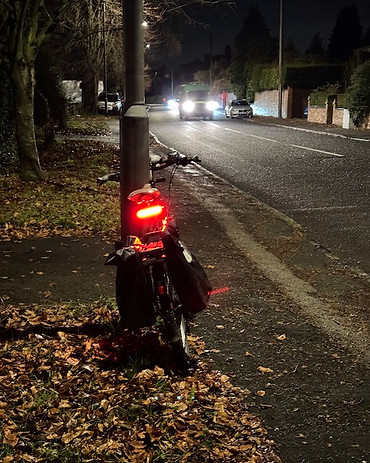
Of course, education is part of the issue here, so using these supports their cause. I’ve used indicators before and they do seem to add presence on turns. As indicators the Unit 1 lights guide the eyes to the turn as opposed to just flashing on the right or left. Moreover, synced, as they can be, they got your back … and your front. Add on the helmet rear light and …. that’s buying into the system. A driver, who followed me in to a pub cark park asked me about them. His opinion, they added to visibility and were a handy supplement to my out-stretched arm. Much of that would be true of other turn signals.

Although the Unit 1 system as a whole seems to say commuting-utility-urban, the lights could be equally at home on longer rides, or, maybe, sitting in your bar bag charging away if you have many miles to go and night will soon close in. Remember that 18hours on 100% beacon mode? Well, you’ve got all night covered and most of a dull day as well. Thus, I would use them on full day rides as daytime runners, as well as for multiple commutes. On the other hand, three hours on 100% solid amounts to three one way trips.
Value 3.75/5
In my opinion, the big decision is whether you want to buy into the Ubit 1 system. True, these lights are effective in their own right and customisation through the app for £169 is far from outrageous; in fact, there are plenty of less sophisticated lights whicvh will still take £50 or more out of your hard-earned. Do remember, you are getting two lights, a charging case, and a very adaptable mounting system. The package costs a lot, but is on the lower side when compared with many smart dual light sets – and offers wider potential than many.
The SeeSense range of lights offers many similar features in terms of smart functions and tuneability. The SeeSense Agile rear light (and its front counterpart) (soon to be arrive on the market at the time of writing) will retail at £49.99, offer an IPX67 rating, and promise similar lumens with reactive technology, amongst other things. Meanwhile their Icon 3 set will set you back £199, with significantly higher top-ends, customisation, and other reactive smart features. Neither, of course, can be synced with your helmet light. For a taste of the Icon lights, see Michael’s review for the Icon 2 rear light.
I have become very fond of the Ravemen NT101 Smart Tail Light, a relative snip at £59.99. No app or customisation, but remote control included, indicators, alarm, horn, and a decent range of modes. Then there’s their sensored rear lights, such as the CL06, and their plain but potent TR range, with models belting out up to 500 lumens (TR500).
Slightly different, was the Cycplus L7 Radar Tail Light (£81.12). Highly tuneable. Brake light, radar detection of vehicles approaching from the rear delivered to your phone, and a surprising powerful light for such a dinky lens.
The other big factor affecting value, may be how much you enjoy tech and synced systems. That is a personal factor. If you enjoy those things, then the value of the Unit 1 Smart Light Pro Dual soars.
Summary
As part of a synced system these are very impressive lights; standing alone, they remain highly functional and with a number of smart features not always available at this price point. Tuneability makes these ideal for commuters and utility riders, with potential for longer rides either as main lights or auxiliaries. The charging case is a real plus, very helpful for camping weekends, for example. For long winter rides, I’d still like a kick-down or a bit more power for longer.
Verdict 4/5 sophisticated lights at a decent price as part of a system or in their own right.
Steve Dyster
PUBLISHED DECEMBER 2025


